Monday, July 29, 2019

CX Life cycle management for continuous improvement in Customer Experience and Revenue/Customer


Customer Experience is like a product created for customers and it displays a lifecycle similar to product life cycle. It has the four stages of Introduction, Growth, Maturity and Decline. During Introduction phase, a new initiative is implemented by an organization which starts getting noticed by customers through the experience they get during various transactions with the company. The pace of receiving a new customer experience is slow and sporadic. People start talking about this new experience in person as well as on social media and the rate at which customer throng to get this experience increases significantly. Advertisement by the company about the change also helps picking up the rate.
This is the Growth phase during which a large section of customer are trying out this new experience. The hype creates a pull for new customers to try out the new experience and presents significant potential for the company to acquire these customers and retain them. More customers connect with company, do more and more transactions and provides a positive impact on the overall revenue as well as revenue per customer. When the initial euphoria of new experience is over, the customers start expecting this experience to be available and the speed of new customer addition slows down, the customer transaction volume remains steady. We are now in Maturity phase. This phase also keeps customer experience more or less at same level. This phase also faces a challenge in terms of competition trying to start initiatives to give same or better experience. The customers are in two minds but most of them continue. How ever some of the customers start building a customer experience fatigue i.e. the experience, which thrilled them some time ago does not excite them anymore and they start looking for something more, something different. They then start losing interest and try out a different experience offered by competitors and company start losing customers along with the revenue. The decline begins. If company does not take any action, the decline continues and company will continue to lose its customer and revenue. 
A few things that needs to be addressed by a company to grow their business. First; Growth phase should be short and rapid where the acquisition of customers as well as customer revenue occurs fast in a short period of time and second; Maturity phase should be stretched as long as possible so that company is able to maintain high level of customers and revenue over a period of time. Ideally company should be able to create another intervention at the right time so that a new life-cycle with new experience starts and impact of decline phase is arrested before it begins. Company needs to acquire mastery over two aspects
1                     Identification of time when new initiative needs to be introduced
2                     Creating a specific new initiative every time so that the cycle continues
The right time for intervention could be determined through measuring customer experience fatigue. As soon as customers provide indications of fatigue, it is time for intervention. The signs of fatigue are stagnant revenue, stagnant rate of new customer addition and introduction of similar experience initiatives by competition. If a company regularly goes through the customer numbers and revenue numbers for specific category (where the initiative was implemented) it can find the trend and catch the moment when a slight declining trend is observed. It can also watch the social media to understand chatter about its experience initiative and initiatives by competition to see if it is going to trigger the decline phase for its initiative.
How do we identify what kind of intervention to be introduced? Intervention should address the right needs which are near and dear for the specific customers who are experiencing fatigue. For which company can use the differentiated needs pyramid method, where in we can create a pyramid with differentiated needs of customer that we are trying to fulfill. We create such a pyramid for our segment of customers and map the existing initiatives against various needs. This will provide us the white spaces where company has not addressed, and competition is trying to address. Then the company can create an intervention targeting specific needs/white spaces so that the interventions are effective and provide the desired outcome of restarting the cycle. The following blogs provide detailed methodology for creating a differentiated needs pyramid for specific customer segment. 
Customer Experience Improvement using Differentiated Needs Pyramid (Maslow’s theory) --https://personalandprofessionalexcellence.blogspot.com/2018/03/customer-experience-improvement-using.html
Predictability in Customer Experience Improvement – A Perspective for Grocery Retail Industry ---https://personalandprofessionalexcellence.blogspot.com/2019/07/predictability-in-customer-experience.html?_sm_au_=iVV4Rtj4p0NLfDVr

In summary, Customer experience has a life cycle of Introduction-Growth-Maturity-Decline. Every intervention created by company will flow through these phases and will stop giving any results in due course. An injection of new intervention at right time can restart the life cycle and enable companies to maintain higher customer experience as well as higher revenue per customer.

Wednesday, July 3, 2019

Predictability in Customer Experience Improvement - A Perspective for Grocery Retail Industry

With significant competition and similarity between products as well as operating models, it has become extremely difficult to differentiate your products and company. Even price is no longer a differentiation due to price-match policies followed by many players. Customer buy from certain vendor only if they “like” to buy from this vendor. Herculean efforts are being made by different companies to create that unique differentiated experience for every customer which creates the love to transact with the company again and again.  Although multiple actions are taken by companies, predictability in terms of action and desired result/outcome with respect to customer experience is still a challenge.
In my earlier blog Customer Experience Improvement using Maslow’s theory,    https://personalandprofessionalexcellence.blogspot.com/2018/03/customer-experience-improvement-using.html, I have described a framework that could be used to get a better understanding of the customer and create actions to address his/her needs to improve the experience provided by the company. In this blog, I have taken an example of Grocery Retail business and discussed the application of this framework to build predictability in improving the customer experience.
As described in the previous blog, differentiated customer experience levels for a grocery customer are defined. Which start with lowest level that customer will buy form them i.e. “Customer is OK” moving to “Customer being comfortable”, then to “feeling at home” then going “on a high” when he/she shops at the specific grocery shop; Ultimately reaching “Nirvana” while shopping at this store. As certain needs get satisfied, customer moves upwards in step wise manner from “Customer is OK” to “Customer feels Nirvana”. The key for Grocery chain is to create appropriate interventions which will satisfy the right needs at right levels for right set of customers, thus pushing the shopping experience upwards. Accurate identification of needs which would result into specific level of experience, is critical to build predictability in the customer experience improvement program for any Grocery chain. The needs of customers could be identified at multiple levels based on the strategy being adopted, it could be all customers together or customers segmented based on parameters like age, sex, income, race, geography, etc. Predictability in desired improvement is directly proportional to the granularity of the segmentation and specific needs assessment at each level.
For understanding purpose, I have analyzed the needs using two customer segments based on age i.e. “Age > 50” and “Age < 30”. Following picture provides details regarding interpretation of specific experience into what it means to them.  We can see that the needs of both the segments are different and experience that each action will create for these segments will be different. Knowing this relationship will help in building predictability for the company.  
Let us look at the need for “Customer is OK” to shop. The 50+ segment looks for ease in physical access as key whereas 30- segment looks for online access as important.  Which means if Grocery chain does not have online store or online order and pick up at store facility; there are less chances of attracting any younger generation customers to shop with them. The younger generation will feel “nirvana” if they are able to order anything using their mobile phone and get it delivered at home. However same feeling is achieved differently by the 50+ segment. If a grocery chain creates a free wi-fi facility and a café where customers can spend as much time as they want, the 30- generation feels it like home and will visit more often whereas there is no impact on customer experience for the 50+ segment. Grocery chains can create this needs pyramid for various customer experience levels for the specific permutation / combination of their customer segments they run their business with and start building interventions specific to specific improvement desired for specific customer segment thus building desired predictability.
In summary, identify right customer segments, build needs pyramid for customer experience levels, create interventions addressing specific needs of specific segments, achieve specific improvement in customer experience.


Monday, June 10, 2019

Improve Customer Experience through “Say-Do ratio”

As mentioned in my earlier blog “Excellence through Say-Do Ratio”,  https://personalandprofessionalexcellence.blogspot.com/2013/09/excellence-through-say-do-ratio.html,  Say-Do ratio is a simple yet effective tool to achieve excellence. In this blog, I am going to talk about how it can be used to improve the customer experience between various seller/customer pairs.

Let me quickly recap the definition of Say-Do Ratio to help us with our topic of the day.  Say-Do ratio is a ratio which depicts adherence to the commitments made, i.e. commitments adhered / commitments made.

Customer experience is a result of interaction between the response a customer gets throughout the process to procure any product/service vis-à-vis the expectations he/she has, before starting the process. If the response matches the expectations, customer brands it as a “GOOD Experience”, if expectations are not met, the experience varies on the negative side and if customer gets something beyond what is expected, the experience gets labeled as SUPERLATIVE. If we keep this simple rule in mind and apply Say-Do ratio, we know if our customers are going to get a Superlative experience or not. Customer expectations are the “Say” portion and response from process (how customer is treated) provides “Do” portion of the ratio.

Expectations are the perceptions created in the minds of customer by the communication received from seller and as understood by customer. Accurate, precise and transparent communication helps in building right customer expectations, which a seller can surpass while servicing them to achieve the desired SUPERLATIVE customer experience. A flier that goes to customer or an e-mail offer that goes to her mailbox or an advertisement that is aired on the local FM channel are some of the tools we have at our disposal to influence the expectations. Many times, we find that flier contains a super duper offer in big bold type (a great hook) with exclusions and other terms & conditions in small type. Customer is likely to miss reading these exclusions as well as terms & conditions; as a result, expectations created in his/her mind are without the conditions mentioned in small type. So even if we are stating the correct things (legally right), we are not creating the appropriate expectations. When customer comes to store to avail that offer and is denied because of some conditions (which are not read by her), it creates a huge negative experience in her mind. You are adhering to the things which you have stated in your communication but have created a negative customer experience. Let us look at two communications “75% discount on product A till the stock lasts” and “75% discount on product A for first thousand customers” the second communication creates the right impression by telling customers that they should be among first 1000 customers and if they miss it, because they are late, the experience does not get impacted, where as if customer has received first communication, she does not know how much is in stock. If she does not get the product at the discounted price, she always thinks that the number of items on sale were very few and the advertisement was only a gimmick which creates a clear negative experience.

A right balance between creating a pull through glamorous advertisement and stating facts about complete offer which will not be missed by the customer can help in terms of creating reasonably accurate expectations in the minds of customer. What do you say, how much do you commit, what are the boundaries, etc. The communications could be for the Homes that a builder is selling or Refrigerator a store is selling or it could be Services an IT provider is going to provide; succinct and adequate communication about what customer is getting like features, price line/discounts, warranties, timelines, deliveries, after sales services, etc. shapes the expectations of the customer. These transactions have long lifespan and every aspect of communication plays a role in different interactions at different stage in the life cycle and customer experience starts shaping up as customer progresses through these stages.

We have seen that how we can get a correct denominator (customer expectations) and what can be done to “Say” it right to customer, it is time to surpass what we have said through what we “do”, how we transact with customer during every interaction of the process. Since we know exactly what we have said and can estimate reasonably well about the expectations that will be created in the minds of customers, we can prepare ourselves to surpass the expectations.

Continuing with the example in the earlier paragraph, if the advertisement was to provide 75% discount to first 1000 customers and in case of real rush, you can create a superlative experience by adding some more quantity to the discounted stock. In this process you have created a SUPERLATIVE experience for the customer no 1001 onward. One of the areas where COSTCO creates a superlative experience is through implementation (“do”) of their return policy for their customers. Some of the insurance companies create a significantly negative customer experience through their unfriendly behavior during claims processing. You know exactly what you are committing so commit in such a manner that when it is time to “do” you can do much better than commitment. Modulating what you Say based on what you can do can help in improving your Say-Do ratio thus customer experience.  Start measuring the Say-Do ratio for your key deals, transactions at multiple locations, with multiple customers and see if you have the ratio greater than 1, if yes, you are doing good and continue to do the same.


Wednesday, November 21, 2018

Digital Transformation through Connected Processes


Digital is an all-pervasive phenomenon and the industry is trying to wrap its arms around it to extract real business benefit it promises. It is omnipresent and all aspect of business, from customer at one end and supplier at other with production-logistics in between, can be transformed using Digital. Creating a compelling experience with every interaction with customer is one of the key benefits apart from other efficiency / financial benefits on back end. Companies are experimenting in different technology areas like Cloud, Mobile/Internet technologies, IOT, AI, ML, Deep Learning, Robotics, Big Data and experiencing some benefits. It is still in the nascent stage for most of the organizations and experiments are being done in for limited area/topic. Industry players are not certain of what needs to be done to achieve Digital Transformation holistically and reap benefits to its true potential.
There are three important components of Digital i.e. Data Capture, Data Analysis and Business Application of the same. It is critical to understand each one and their relative dependencies to define the road map for transformation. This paradigm is different than the one we are used to for several decades. There is no dearth of data points, there is too much data, too much variety and significant speed of evolution. The critical factor for digital transformation is to identify most effective and economic way of capture/usage of this data for transformation of business. 
This blog describes one method, if followed by the organization, can provide an effective way of using digital. The method involves CONNECTED PROCESSES. Let us take example of customer information.
Customer information in various forms is used in key processes like Marketing, Sales, Merchandising, Procurement, Warehousing, Delivery logistics, Customer service, Incentive planning for sales persons, Product design, Product planning / manufacturing, etc. With the level of customer centricity organizations aspire to build, customer information in one form or other will be used in all the business processes.
This customer information is available from various sources and in various forms. The information is available from internal systems like Customer master, Purchase Orders, POS information, Loyalty programs, Customer complaints, Returns, etc.  There are indirect data points like Response to promotions, Response to social events / campaigns run by the company, etc. There is a third capability of obtaining tertiary information from social media, wearables, online transactions, etc.      
It is a Many-to-Many maze which creates difficulty for an organization. The dilemma is how to decide on what type of data to collect, how to collect i.e. what hardware / software they need to invest in as well as how to use the data i.e. what treatment that needs to be given to the data or what information should be extracted from the data intelligently vis a vis transformational benefits expected to receive. On top of this, the technology is changing rapidly, posing further challenge of selection of technology which will not be obsolete at least till it recovers the investment made.  
One of the method to simplify this journey is creating a map of connected processes and mount a layer of digital on top of it.
Let us take an example of a process of point of sale transaction at a store where customer is paying for the goods purchased. The step by step process map of this sales closure process could be:

·         Scan the items
·         Scan the loyalty card / Telephone no.
·         Apply applicable discounts
·         Scan the customer credit/debit card or receive Cash and complete payment
·         Bag the item and give the receipt to customer
·         Say thank you
Each process step requires help from other processes e.g. when you scan item, the bar code reader scans it, goes to the Item master, searches information like make (brand), design, color, size, price, etc. and displays the same on the screen. Similarly, when the loyalty card is scanned, or telephone number is provided, the CRM system is accessed. It fetches customer information like name, address, status, etc. and displayed on the screen so that the employee at POS terminal can greet customer by name. Similarly, it performs remaining steps and it either fetches or updates one or many systems in the background.
Now assume that Digital transformation team working on enhancing the customer experience believes that the experience could be enhanced if we build some intelligence in the system and make it available to the employee at POS counter to create a lasting experience. One of the idea could be “Creating special PERSONALIZED discounts/ offers ON-THE-FLY in additions to the discounts published. Each person gets specialized discounts / offers which has a significant potential for increasing customer experience as well as improvement in business volume and basket of products that a customer would buy. It would really please a customer if he/she gets special discount when he/she returns to store after a long time and gets a coupon for the brand of cloths he/she likes for the next purchase. A person would be very happy to get special deals on furniture, home decoration when he has just closed a home. Customer would definitely come back if he/she gets a gift of shirt / dress (brand which store wants to promote) based on purchase volume. A deal on travel, based on a personal event like marriage, kid getting admission to college where he/she needs to travel. Customer getting a special discount on merchandise of his favorite football team. The base idea is to create these offers without asking customer but using an AI engine which uses the information captured from multiple sources. The diagram below depicts the new process  steps for the same process at POS and how it can be implemented.
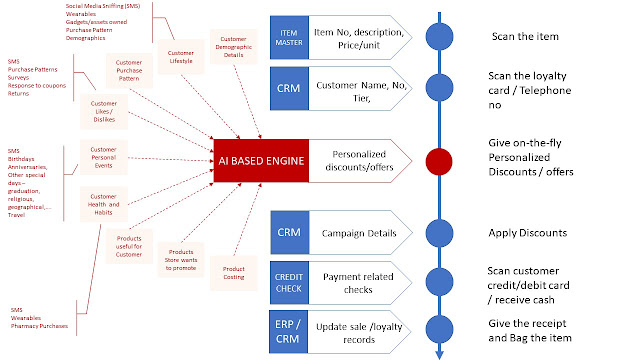
This has all the classic components of digital i.e. multiple aspects of information gathering, storage and building an intelligence from the data collected to create a memorable experience for customer. The diagram shows a different mechanisms of data collection which need to be deployed. The variety is significant and so are the challenges around selecting an economic way to deploy these mechanisms. It is the relationship between “Mechanism of data collection”, “what components of data” and “How this component to be used” which guides the path forward.
Let us take example of two mechanisms depicted in the diagram i.e. “Social Media Sniffing” and “Returns”; one appears in every aspect and one appears for only one aspect.
Social Media Sniffing is a vast area which starts from Facebook, Instagram, Twitter, and goes on.  The objective of this sniffing is to create certain profile of customer with specific view point which is required to help achieve the objective of process underway. Let us consider “Customer Likes /Dislikes” as one such view point; we are using this view point to create a personalized offer to customer at the point of sale. However, the same view point can be used in multiple processes such as Online Sales, Mobile Sales, Campaign formulation, Merchandising, Product Design. These processes are connected, and the binding glue is “customer likes/dislike view point”. Each process may use a little different processing of sub components as per its need, but the base data is common. This exercise provides a clear list of what data components need to be captured for every customer. Once we know this, we can look at the tools/ technology available at our disposal e.g. is it sufficient to look at Facebook data only or we need to look at Facebook, Twitter, Instagram or may be Tinder, etc. Which then provides us the mechanism that we need to adopt, is it going to be only indirect method, or we need to look for some direct methods like surveys (which could be designed based on holistic requirements for more than one processes) or just use the data available in the CRM system.
We have seen that Social media sniffing can be used to create some other viewpoints also like “Customer lifestyle”, “Customer Health”, “Customer Personal Events”, etc. These viewpoints are now used in multiple different processes and we get some additional data points that needs to be captured using the same or different tools / technology. These are the important points that needs to be kept in mind while selecting technology for its holistic application.
Same principles apply to the “Returns” also. The returns information is used in multiple processes in the organization in different but unique ways. e.g.  Any “Feature Dislike feedback” from this info is useful for Product Design Process to see what could be improved so that product is attractive to the customer as well as it becomes part of Like/Dislike view point. Any “Non-Performance feedback” is useful for Manufacturing process to understand if any improvement needs to be done while manufacturing the product.
Any “Damage in transit feedback” helps the Logistics / delivery process to see if something needs to be improved. This feedback is typically captured in the returns transaction either through a form filled by customer (Physical / online) or the interaction customer service agent has with the customer at the point of return. Many a times, this may not be the real reason. Company can use other methods like customer purchase history, their likes and dislikes on social media etc. to collect and corroborate the data and get the real returns view point/ information for driving improvements. This aspect of collecting data from tertiary sources to corroborate the data collected directly takes it beyond aspects of “Returns” and gets connected with multiple other processes in the organization which are planning to use mechanism of “Social Media Sniffing”. It has created two maps of connected processes.  
Thus, creating connected process map/s help us understand the ultimate data that we need to collect and the technology that we should use for the same to bring in desired digital transformation in holistic manner and reap the desired benefits.

Monday, August 6, 2018

Very few people EXCEL in personal / professional life, Do you? – a simple mantra to try!


There are a few leaders in the corporate world, who have provided a steady growth to their organization while they were disrupting the industry at the same time. You see this phenomenon in non-corporate worId also. I observed them to understand what is their secret sauce; what is that they have done which enabled them to excel surmounting the odds. 

After a careful study, I observed one common theme across all these people, their secret sauce. They believed in one simple rule and implemented it rigorously in all aspect of business or any non-business operations managed by them. They made it a point that everyone on their team understands it and incorporates it in their part of work for the organization. The rule typically is so simple that it is very easy to understand and key for winning is its comprehensive implementation across all aspects of business.

Let us take one well known example of Steve Jobs; he believed in the simple rule of “Be Yardstick of Quality”. It is easy to understand; it means the industry should look at apple products for what it is called as “best quality product” and build their products to reach those standards. This is easier said than done though.  It means all aspects of the product right from conceptualization, design, features, performance, manufacturing, distribution, sales and finally service; all aspects, should demonstrate this YARDSTICK QUALITY and being in commercial world, the product also should be price competitive in the market. The apple team, has taken this rule of “be yardstick of quality” and implemented it comprehensively in all aspect of business and result is in front of us. It takes a significant effort to incorporate the theme in all aspects of daily working when there are multiple external and internal stakeholders / partners doing their part to get the product in customer’s hand.

There are several examples like this; " Put the Customer first, Invent and be Patient" by Jeff Bozos; “Be no 1 or 2 in the industry we operate” by Jack Welch took GE to new heights. Similarly, “Non-Violence” by Mahatma Gandhi created a huge freedom movement in India leading to its independence. There are several such rules come to my mind like “Just Do It”, “Be Authentic”, “Do what you say”, etc.

One of the common theme we hear from various people / organizations is around “Customer Centricity or Customer Focus”. Different companies and their leaders provide their own spin of this theme. When we observe these organizations, we can clearly see difference in their performance, perception of their customers about them, their product portfolio, their customer service based on level of depth they have gone to implement the theme they proclaim. The organizations, which have primary focus on customer benefits in preference to regular things like cost, profitability, etc. are seen to be performing well on all fronts, including profitability.

This same thought process or mantra could be extended to an individual who wants to excel. First step is to identify a rule that resonates with you; it could be simple as “Respect Others”, “Do as you say”, “Make others smile” or anything personal like “save 20% of my salary for future safety” and Next step is to implement the same in all aspects of your life and see the miracle. Start small, experiment with it and then create your own niche.

Once again, the Mantra to excel – “Believe in Simple Rule and Implement it rigorously in all aspect of business / personal life”

Friday, March 9, 2018

Customer Experience Improvement using Differentiated Needs Pyramid


The current wave of transformation in the industry is led by the combination of Customer Experience and Digital Technologies associated with it. Industry has already reaped significant benefits from ideas of Volumes, Global and distributed manufacturing (Low cost geographies), Process optimization, etc.  Now the industry has reached a stage where most of the competing products in any specific category look similar in specs, performance, price. The only ray of light for retaining and growing customers is through creating an experience which will compel customers to repeat the process again and again. As an old saying goes that “Satisfied customer will keep the satisfaction to himself but a Delighted customer will spread the story to others”, the companies are vigorously working on building a great customer experience.
The customer experience themes and actions have now moved from touchpoints to journeys; the responsibility to drive implementation has moved to the leadership levels in the organizations. Consulting organizations like McKinsey have built models around how these journeys should be undertaken by the organizations to reap the maximum benefits; Forrester Research have defined six disciplines for great customer experience i.e. strategy, customer understanding, design, measurement, governance and culture; Wharton's Professor of Marketing Barbara E. Kahn has established an evolutional approach to customer experience as the third of four stages of any company in terms of its customer centricity maturity and so on…. There is a significant variability in this exercise as it depends on selection of journey which is determined by the interplay of strategy, business criticality, customer feedback, competition, organizational change required, etc. These factors are different for each company and thus each journey for each company is unique giving rise to anxiety and uncertainty of its success.
I feel, if one uses the good old Maslow’s Theory to create a differentiated needs pyramid while designing Customer Experience improvement initiatives/actions, the results could be effective and predictable. 
Briefly speaking, Maslow’s theory states that people are motivated to achieve certain needs and that some needs take precedence over others. Our most basic need is for physical survival, and this will be the first thing that motivates our behavior. Once that level is fulfilled the next level up is what motivates us and so on. The hierarchy includes Physiological, Safety, Belonging/Love, Esteem and Self Actualization in that sequence. There might be cases where some needs at higher levels get satisfied before lower levels but overall trend for large % of needs follows the hierarchy. The first four levels are called as deficiency needs i.e. they arise due to deprivation and intensity of these needs is directly proportional to the level of deprivation and the top most needs in the category of Self Actualization are called as Growth needs, which helps person in his/her individual growth. 
If we keep this hierarchy in mind and build a hierarchy of needs of customers for a product / service a company is offering, it provides a superior insight in to extent of change in customer experience in response to specific actions undertaken by the company. Let us take an example of grocery retail store and see how it works.
I have defined one such hierarchy for grocery retail and distributed various needs of customer in to various levels of the pyramid. 
For a customer, the physiological needs from a Grocery retail store would be something like, store should be easily identified by name signs and has basic things like parking, access, etc., the stores should have the most of the essential goods that the customer would be looking for, once customer enters stores, there should be a fair identification of isles v/s products to find the products easily and the stores should not be dirty.
Moving upwards to safety related needs, which cover physical, financial and other securities, would include things like detailed isle marking, properly stacked products easy to reach and remove, there are no boxes lying around and one can freely move around with no hindrance, clean and effective mechanism to keep it clean and finally you have a variety of products to choose from.  If all these things are present, then customer feels better than the store which can fulfil only physiological needs; and chances that he/she will come back are higher.
The next level of needs would include extension of products beyond Grocery, which is main purpose for customer visit, like cloths, furniture, gift articles, home décor, etc. or a restaurant, a coffee shop which could help shopper to spend some time relaxing after the Grocery shopping or some activities like cooking workshops, kids arts/craft workshop, etc. These things start building an emotional connect and satisfying multiple needs of customer beyond Grocery. This emotional bond plays an important role in bringing him/her more frequently to the store.
When we extend this emotional bonding through some highly specialized things like significant variety/choice of specialty foods like vegan, glutton-free, fat-free, sugar-free, organic, etc. or the whole store associated with any specific sport/sporting team or philanthropic activity or a gourmet restaurant, creates a CULT LIKE FOLLOWING with some of the customers. These customers are PROUD of the store and how it fulfills their needs; they visit often and strongly recommend the store to their friends and family.
The self actualization level for a store could be catering to customers by their specific needs in all the levels without being asked; if there is a shift in the needs, the store is capable to reflect and re-present themselves to their customers. Which is very difficult but could be aspired by grocery stores to achieve through latest technologies in AI/ML.
When an organization is building strategy and actions to enhance their customer experience, this Maslows hierarchy based mapping comes in handy. We should do a simple assessment for each action with respect to which customer need gets fulfilled. Depending on the level of the need which gets fulfilled, the impact on the experience and subsequent improvement in sales could be assessed. If the need at physiological level gets fulfilled, we may not see any significant change in the customer behavior, but if the need at belonging or esteem level, we can see tremendous impact.
So when we cross check our strategy and actions there in with this hierarchy we understand two important aspects
1                     Is there any types of need that are not being addressed? which means we may not reach desired level of customer experience.
2                     What kind of change we should expect from the customer after implementation of these actions.
Based on the result of assessment, the strategy and actions could be modified before implementation. This proactive approach will save missteps, wrong investments as well as miscommunication and ensure a significant positive impact on customer experience.
I have explained the concept with one example, the needs pyramid will be different for each company even if they are in the same industry segment. If each company spends energy to build such pyramid for their product/s, they can refine their strategy for improving their customer experience to give expected results.   

Thursday, June 15, 2017

Next frontier of excellence in Customer Experience – Extreme Personalization

Customer experience is one of the things which is keeping C suite executives awake in the night. As a result a we see slew of initiatives implemented by various organizations in the hope of improving the experience provided to the customer in every interaction. Significant investments in technology and algorithms have been made and continued to be made in order to understand customer & their needs to build a great experience mechanism. Companies have used AI, Machine learning, IOT, Robotics and a whole lot of analytics platforms to come out with such mechanisms which will elevate customer interaction.   
Some of the areas where companies have worked are
·      Proactively identify the product customer may want to buy and build some special schemes around the same
·    Reduce the price points and increase convenience points through multiple aspects like efficient operations, Direct to customer, free delivery, same day delivery, order online and pick up at the nearest store, etc.
·     Provide a significant choice to customer and make return easy to reduce the hesitancy of impulse buying
·        Use social media information and create a product for specific groups and provide a special deals for specific group
·         Train the last mile employees to provide a great experience at every touch point with customer
·         Creating a powerful online channel to help customers buy from where ever and whenever they want to buy
All the efforts are towards making buying process delightfully rewarding to customer that customer returns to buy more as well as provides word of mouth publicity.

It is also important to note the temperament of the current generation; they do not want to go out to stores to have a feel of the product they want to buy but they are happy to order it from their mobile phone. There is no loyalty for a seller/shop, who so ever provides lower price, good return policy gets the deal. Although brand plays a role in decision making but convenience and price determines the purchase decision.     

Companies like Amazon, Walmart have leapfrogged in this art and are creating more and more mechanisms to engage the buyer meaningfully. I call these mechanisms as Gen 1 mechanisms which involve changing / optimizing/ improving everything around the product. The next step in this would be to include product itself in building the lasting customer experience.

The Gen2 of mechanisms will include the product and extreme personalization will be at core. Simply put, enable customer to define /design product of their choice and provide the delivery with the same efficiency and convenience we have built in the Gen 1 mechanisms.

One example, in today’s situation, if one wants to buy a Shirt , first you visit a website, you choose style followed by selection of either color or pattern from the list available in the size that fits you. Select delivery option and see the total price. Normally, person will check on multiple websites if the same brand and similar shirt is available on any other website and finalize the decision based on the best pricing.   The next generation of disruption is going to come from extreme personalization i.e. by allowing customer to design their product. If we translate this to purchase of shirt situation, then it will be something like this – you visit a website for shirt, every one does not have a great chiseled body and std sizes do not fit them properly so you provide your photograph so that your measurements are understood by the company. Then you can choose the cloth, pattern, etc. from a significantly large repository of designs and cloths. The website provides you with the picture of shirt with your specifications worn by you (using the photograph provided by you). If you like it, you can place an order. It will be manufactured to your specific size, design and shipped you efficiently. It is a tailored shirt purchased with convenience of sitting at home and price of a mass manufactured shirt and delivered to a destination of your choice.
  
It will be a 100% “made to order” scenario, but a completely automated to remove any manual work typically involved in “made to order” scenario. The technological development in terms of machine to machine connectivity and various facets of automation will allow us to share the order from a mobile phone to the shop floor which will manufacture the goods to the specifications provided using the raw material for specific order and then it will be shipped to specific address. This will create a significant impact on the entire industry as companies will not have any stocks of finished goods, no warehouses for finished goods, no worries as to how to take out the unsold stock, etc. The warehouses will only hold stock of raw material and you will have many automated specialized plants to manufacture specific category of products connected with the websites picking up orders. With 3D printing capabilities getting evolved, this can be enhanced significantly. It might look impossible at this juncture as it will need to dismantle the whole industry and rebuild it with new principles, but the competition will drive us to conquer this new frontier of extreme personalization to create that super duper customer experience.      


Wednesday, April 12, 2017

Nine Step process to Improve Customer Experience

As described in my earlier blog “Customer Experience and Organizational Excellence”, customer experience has a start (your current level) but no end point and it needs to be improved perpetually. If we do not improve the level of customer experience, it automatically degrades itself. The kind of experience we can provide to customer depends on how well we know the customer and our urge to provide customer with great experience during every interaction. Since it is proven that the top and bottom line gets affected directly by the experience a customer gets while interacting with our company directly or indirectly; it is natural that we want to give the best experience and the “urge” for the same is assumed to be given. So the manifestation of experience directly depends on how well we understand our customer. Do we understand their needs, wants and aspirations?, Can we really think like them?, Do we know how they will react or perceive us if we take a certain action? It is a complex, multidimensional, and nonlinear process due to multiple variables like changing environment, churn in customers, technology disruptions and competition to name a few. 

I have observed a nine step model in ancient Vedic literature to understand God (Nava Vidha Bhakti i.e. nine ways of devotion) and I feel that if we apply it to today’s corporate world, it provides us a great model for understanding our customer and provide a superlative experience during each of our interaction. I have presented the same in this blog.  The following diagram shows the real names of these nine steps and “Applied Names” when used in context of understanding customer.  
The first one is called “Shravana (Listening to/about Customer) Bhakti” which tells us to listen more and more about customer. Use any channel available at your disposal; be it reading print / digital media, go to different customer / industry forums, conduct some surveys, understand some success stories as well as failures etc. Everything collected predominantly from secondary sources. This gives us a level of perception where we can start visualizing what customer would expect from any interaction with us and we can start building our customer engagement mechanisms.  
The second and third forms namely “Nama Sankirtana” (Chanting about Customer) and “Smarana” (Remembering Customer behavior) are typically performed together after the one has achieved a specific level of perception about customer through secondary knowledge and listening about him from multiple sources. These two forms tell us that we should always talk about customer, keep customer in mind while taking any action or decision. Also remember customer’s behavior in different circumstances and situations, remember how customer has reacted to an intervention by us or competition.  This acts as a positive spiral refining our perception about customer and helps us improve our actions thus improving the experience customers would get in every transaction. 
These first three steps really talk about the homework that we need to do before interacting with customer in order to create a great experience during interaction. This homework prepares us for initiate a satisfactory transaction with customer.
We are now ready and waiting for an opportunity to provide a service to our customers in the most desired manner. The next three forms i.e. Pada Sevana (Waiting on customer), Archana (Worshipping Customer ) and Vandana (Saluting Customer) provide direction in terms of how do we create this opportunity. Pada Sevana (Waiting on Customer) tells us that be around your customer, visit places like trade fairs where your customer is present, observe your customer, take note of what customer is doing. This keen observation and presence will definitely get noticed and opportunity for interaction will present itself.  This when coupled with Archana (Worshipping Customer) and Vandana (Saluting Customer) the chances of improving the customer experience increase many fold. A simple thing like Saluting / celebrating success of an athlete in a large forum of budding athletes by a sportswear company brings this whole thing together. It creates a large group of customers at one place, it provides opportunity to interact and understand the customer base through informal interactions not related to any business transaction, it sends clear message that you value the customer as well as the success one of the customer has achieved and you are happy about the same. It also conveys that you listen to your customer and ready to do things which are not directly related to your business (go extra mile) if necessary.  A company can create multiple such opportunities using Archana (Worshipping Customer) and Vandana (Saluting Customer) to create a supportive background for a memorable customer experience when the actual business transaction takes place.
We have done a lot of hard work in getting ready for giving a great experience to our customer, we have done right things to create an opportunity to do so. I am certain that opportunity will present itself to perform a business transaction and thus provide superlative experience to customer. The next three forms i.e. Dasya (Serving Customer), Sakhya (Be friend to Customer) and Atma Nivedana (Complete Dedication) take us through process of superlative experience throughout the life-cycle of relationship with customer. In the initial phase of your business relationship, you serve customer without questioning, listen to the needs and service them without questioning and try and go beyond what customer is looking for. You fulfill anything that customer demands. This provides a very comfortable experience in the transactions and also provides a lot of insights about customer mindset. This triggers the next form I.e. Sakhya (be friending customer), which means you now start advising customer on what would be right for him based on your knowledge about customer, you start thinking for him and work for him for his benefit. This elevates the experience to a new level. The last one i.e. Atma Nivedana (Complete dedication) is the next phase where your thinking is changed in such a manner that there is no difference between you and customer and you deliver services in a manner that you feel would provide best customer experience without need for asking customer. The key transition that you find here is the extent customer has to drive the transactions and set the expectations. From Dasya (Serving Customer) to Atma Nivedana (complete dedication),  you find that need for customer to focus on what he needs in a business transaction reduces and he keeps of getting the same or more without asking which naturally ensures a great and lasting experience. 
A few questions come to our mind –
·         Are these steps sequential?
·         Do we have to do all these steps?
·         The environment, technologies are changing; so are the customer expectations, what happens to this framework?
These steps grouped in to three groups as described earlier and followed in that sequence. Most of the activities in a group are run in parallel. There are subtle differences, but they can run in parallel. This sequence is for a set/segment of customer/s once you start you can go to the end to ensure great experience. It is better to perform all the activities to reach the ultimate goal of superlative customer experience, if we do not perform certain activities, it may not give us the desired results.
The model has an inbuilt positive spiral to correct the changes which are happening in the environment and then modify the next steps on the go. We are continuously Listening to/about customer, talking about customer, understanding their feedback to firm up our understanding in order to prepare for next steps. This activity is continuous activity and any changes taking place in the environment, technology, customer expectations, etc., automatically refine our understanding of customer enabling effective next steps.    
We can use the two approaches described in my earlier blog, “Customer Experience and Organizational Excellence”, to implement various initiatives to ensure superlative customer experience.
1                     Reverse Planning for a Customer Experience thread
2                     Creating multiple pairs of supplier/customer within ecosystem